
Checking Criminal History in Fairfax County
A useful Fairfax County criminal record check begins with a question: is the reader trying to confirm a court result, find a current booking, obtain a police report, or audit a statewide identity record? These products come from different custodians. The Virginia Judiciary case-information hub is the broadest free starting point for public criminal case indexes. Fairfax General District Court covers misdemeanors and preliminary felony stages. Fairfax Circuit Court covers felony indictments, trials, and appeals. Police and sheriff records then add details that the court index does not hold.
Use the full legal name and likely spelling variants. A date of birth helps distinguish common names when an official form permits it, but the public court index may not display enough identity detail to prove a match. Keep the locality straight. Fairfax County, the independent City of Fairfax, and Falls Church are separate choices even when buildings or services overlap.
- Choose the record type and identify the agency that created it.
- Search the correct Fairfax court by name, case number, or hearing date.
- Open the linked case number and compare charge, status, dates, and disposition.
- Check Circuit Court when a felony moved beyond its General District Court stage.
- Request the signed order or an official personal record when identity or accuracy matters.
Fairfax County Court Search Boundaries
The Fairfax County Judicial Complex stands in the independent City of Fairfax. That address does not turn city police matters into county cases, nor does it make the City of Fairfax part of the county. This boundary is a common reason a name search returns nothing. The towns of Herndon and Vienna are inside Fairfax County and use town sessions within the Fairfax General District Court structure. The City of Fairfax has its own locality identity in the state search.
When the event occurred in Reston, McLean, Annandale, Centreville, or Burke, the likely path is Fairfax County Police and the county courts because those places are unincorporated. When the event occurred in Herndon or Vienna, start with that town’s police records and then use Fairfax County court channels. A statewide name search can help when the summons or precise locality is lost, but the underlying file still belongs to the listed clerk.
Note: A courthouse street address in Fairfax City does not determine whether the record belongs to Fairfax County or the independent city.
Virginia Official Background Checks
The Virginia Department of State Police Criminal Justice Information Services Division operates the Central Criminal Records Exchange, or CCRE. It is Virginia’s central criminal-history repository. It is not an unrestricted public people search. Dissemination depends on the requester and purpose under Virginia law. A person reviewing their own statewide Virginia record can follow the Virginia Criminal History Record Check selector and the SP-167 route. Authorized statutory users follow the form or Non-Criminal Justice Interface route that applies to them.
CCRE is different from the Fairfax County court index. Fingerprint-supported arrest cycles and reported dispositions give the state file a stronger identity link, while court searches show case events filed under a name. Fairfax County Police Central Records also provides fingerprints by appointment for county residents and qualifying purposes. Eligibility, cards, and the current charge should be confirmed with that office. VSP’s Biometric Records Section can explain state fingerprint procedures. The generated VSP form controls the current record-check fee, so no unverified amount should be assumed.
Fairfax County PD-23 Record Limits
Fairfax County Police offers a local self-history check through form PD-23. The service covers the requester’s own adult charges in Fairfax County only when FCPD responded or charged that person. It does not supply another person’s file. It also does not automatically include an arrest made by Herndon Police, Vienna Police, Virginia State Police, or another agency. Two valid IDs are required, including one photo ID, and the posted fee is $10.
The FCPD Central Records instructions show where this narrow product fits. It can help a Fairfax County resident audit FCPD charge data, but it cannot replace CCRE, a court disposition, or an Adult Detention Center record. The official page below is the source for appointment and identity rules.
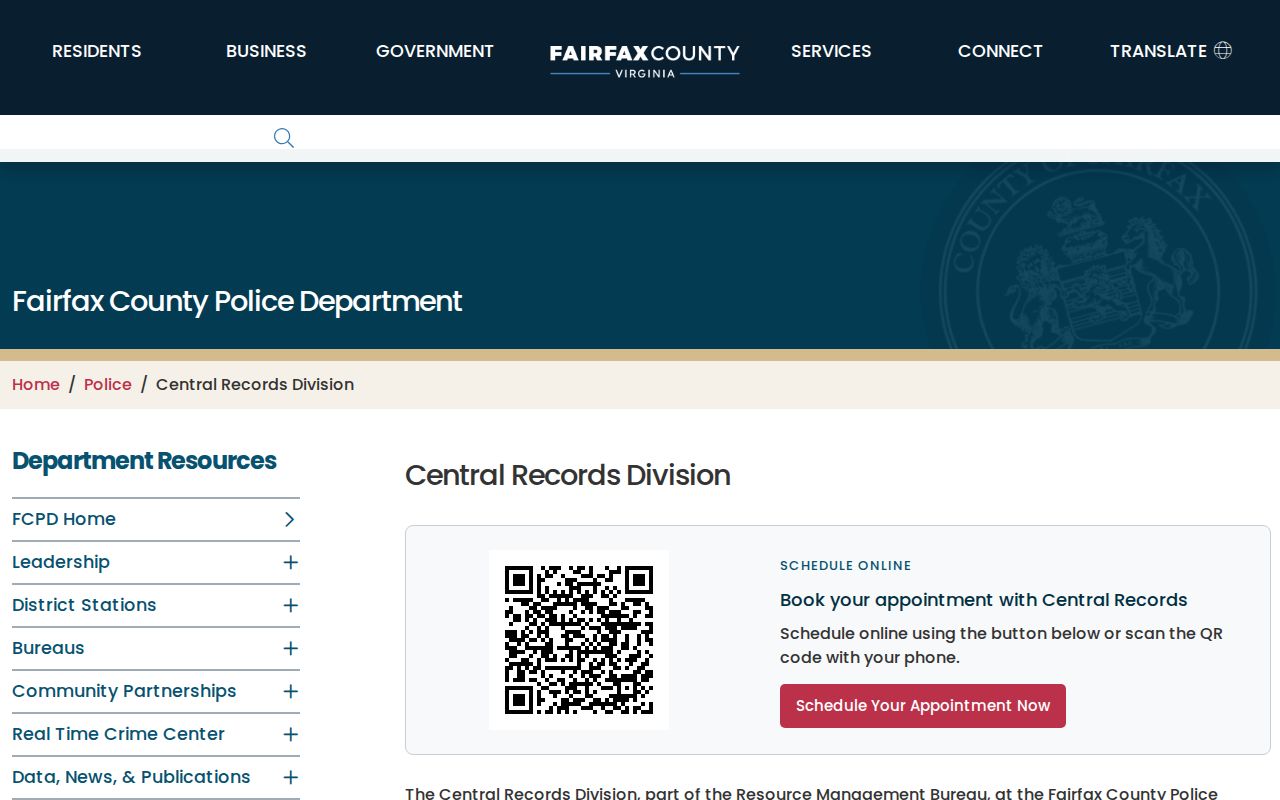
The Central Records screen reinforces a key distinction: a Fairfax County local police check has geographic and agency limits, while a Virginia record request has statewide scope subject to dissemination law.
| Fairfax County channel | What it answers | Main limit |
|---|---|---|
| GDC case search | Misdemeanor, traffic, and preliminary felony events | No juvenile data online |
| Circuit eCaseSearch | Felony and appealed case index | Signed files come from the clerk |
| FCPD PD-23 | Requester’s own qualifying FCPD charges | Local and self-only |
| VSP CCRE | Virginia identity-based criminal history | Purpose and disclosure rules apply |
Criminal Record Types
A Fairfax County incident can create several records without producing one all-purpose file. Police write the incident or arrest narrative. A magistrate may issue process and set bond. The sheriff creates a booking and confinement record at the Adult Detention Center. Court clerks then track the charge as filed, later amendments, hearings, pleas, orders, and disposition. CCRE receives qualifying fingerprint-supported events and reported outcomes. Virginia Department of Corrections records begin to matter when state custody or felony supervision follows.
Readers should match the question to the product:
- Incident report: the police account of an investigation, which may exist without an arrest.
- Booking record: the sheriff’s intake data, custody status, charge, bond, court date, and inmate number.
- Court file: the filed charge, docket events, plea, disposition, sentence, and signed orders.
- CCRE record: fingerprint-linked Virginia arrest cycles and reported outcomes within disclosure rules.
- Registry profile: a public-notification record for a statutory class, not a full criminal history.
Fairfax County Jail Records by Phone
Fairfax County does not provide a verified open county jail roster with public name-search fields. The reliable fallback is the 24-hour Adult Detention Center phone menu at 703-246-2100. Choose the confinement branch for inmate information, bond, release, or court-date questions. The sheriff can also address a focused records request, while VINELink offers custody-status notifications. If a person has moved under state authority, the VADOC Inmate and Supervisee Locator becomes the right search.
The Fairfax County Sheriff’s official page identifies the office responsible for the Adult Detention Center and confinement records.
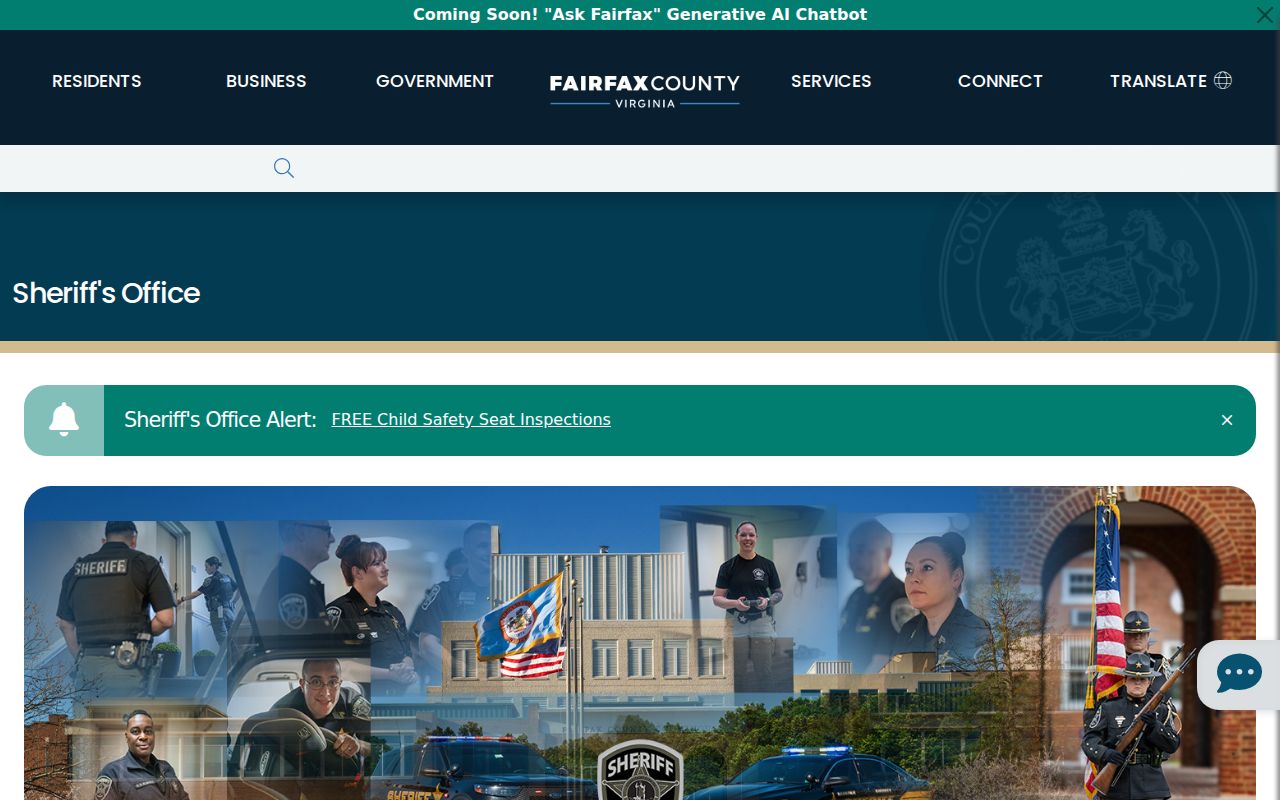
The sheriff page should be used for current contacts because custody vendors and procedures may change. Booking is an intake event, not proof that the charge led to conviction.
Inside a Fairfax County Criminal Record
The contents depend on the custodian. A CCRE record can group identity data, state or FBI identifiers, fingerprints, arresting agency, tracking number, arrest charges, court locality, amended charges, plea, disposition, sentence, and supervision. A Fairfax County court portal is narrower. It can show the court, case number, charge and code section, dates, status, plea, disposition, costs, and hearing events, but it does not biometrically prove that two similar names belong to the same person.
Public indexes also omit some private data and do not provide every scanned filing. The clerk’s signed order is the better source for a final outcome.
| Name and identifiers | Party label, aliases or identity markers allowed for that record. |
|---|---|
| Arrest and booking | Agency, dates, current charge, bond, custody status, and inmate number where releasable. |
| Charge and statute | Offense text, Virginia Code citation, and an amended charge when posted. |
| Disposition | Dismissal, nolle prosequi, conviction, deferral, or other recorded result. |
| Sentence | Custody, fine, costs, probation, and related order entries when public. |
| Supervision | VADOC custody, probation, or parole status where the state locator publishes it. |
Fairfax County Record Numbers Explained
A Fairfax County search can produce several numbers for one event. They are not interchangeable. Copying the right identifier into a request often saves time and cost.
- Police case number
- Identifies the incident or arrest report held by the responding law-enforcement agency.
- Inmate number
- Identifies the sheriff’s booking and confinement file at the Adult Detention Center.
- Court case number
- Identifies the prosecution and docket in General District or Circuit Court.
- DOC ID
- A seven-digit identifier used for the VADOC locator, not the Fairfax County jail record.
- SOR number
- The identifier used by Virginia’s public sex-offender registry for a registrant profile.
An agency may locate a file without its number when given a name, date, and place, but a precise identifier reduces false matches. It also helps when an arrest charge and the later court charge use different wording.
Public Access Laws in Virginia
The Virginia Freedom of Information Act governs many requests to Fairfax County agencies, but it does not make every criminal-history product open to every requester. It also does not require an agency to create a new report or answer broad questions. Ask for identifiable existing records, choose inspection or copies, and request a cost estimate. FCPD ordinarily must give one of the statutory responses within five working days, though criminal investigative files can follow longer rules and active cases may be withheld.
Key Virginia laws:
Va. Code § 2.2-3700 et seq. sets VFOIA policy, response rules, costs, and law-enforcement exceptions.
Va. Code § 19.2-389 limits who may receive CCRE criminal-history information and for what purpose.
Va. Code § 9.1-900 et seq. governs the Sex Offender and Crimes Against Minors Registry.
Va. Code § 16.1-300 et seq. restricts juvenile record access, including public online access.
Fairfax County Police posts an administrative labor rate of $40.6039 per hour for research, redaction, quality review, and production. A deposit may be required when the estimate exceeds $200. Those figures concern FCPD records work, not clerk copy charges or a VSP criminal-history request.
Fairfax County Warrant Search Chain
No verified Fairfax County public active-warrant name database was found. An online case may show a capias or warrant-related event, but an absent entry does not prove no warrant exists. Someone checking their own status should contact counsel or the issuing court. Fairfax General District Court Criminal Division can help identify a public case at 703-246-3305, and its automated case line is 703-246-3764. The sheriff executes criminal process but may be unable to confirm sealed or unserved process.
A caller who demands money to clear a Fairfax County warrant is a danger sign. The sheriff warned in April 2026 that deputies do not demand payment by phone or text official papers. Verify the court and charge independently, obtain lawful bond or appearance instructions, and keep each signed order or receipt. Do not treat an unofficial warrant list as a government record.
Sealed, Expunged, and Restricted Records
Virginia uses both expungement and sealing. Traditional expungement under Va. Code § 19.2-392.2 generally concerns an acquittal, dismissal or nolle prosequi, identity error, or an absolute pardon for unjust conviction. It is not a broad method for erasing any conviction. Juvenile matters are confidential, and sealed records, victim identifiers, Social Security numbers, medical data, and active investigative material can also be withheld or redacted.
Virginia’s automatic and petition-based sealing system became operational on July 1, 2026. The rules can cover specified non-convictions, traffic infractions, and some convictions or deferred dismissals, but serious categories are excluded. Waiting and intervening-conviction rules matter. VSP publishes a Fairfax-specific sealing route so a petition result reaches Fairfax Circuit Court correctly.
The official VSP page below reflects the major 2026 change in Fairfax County criminal record access.
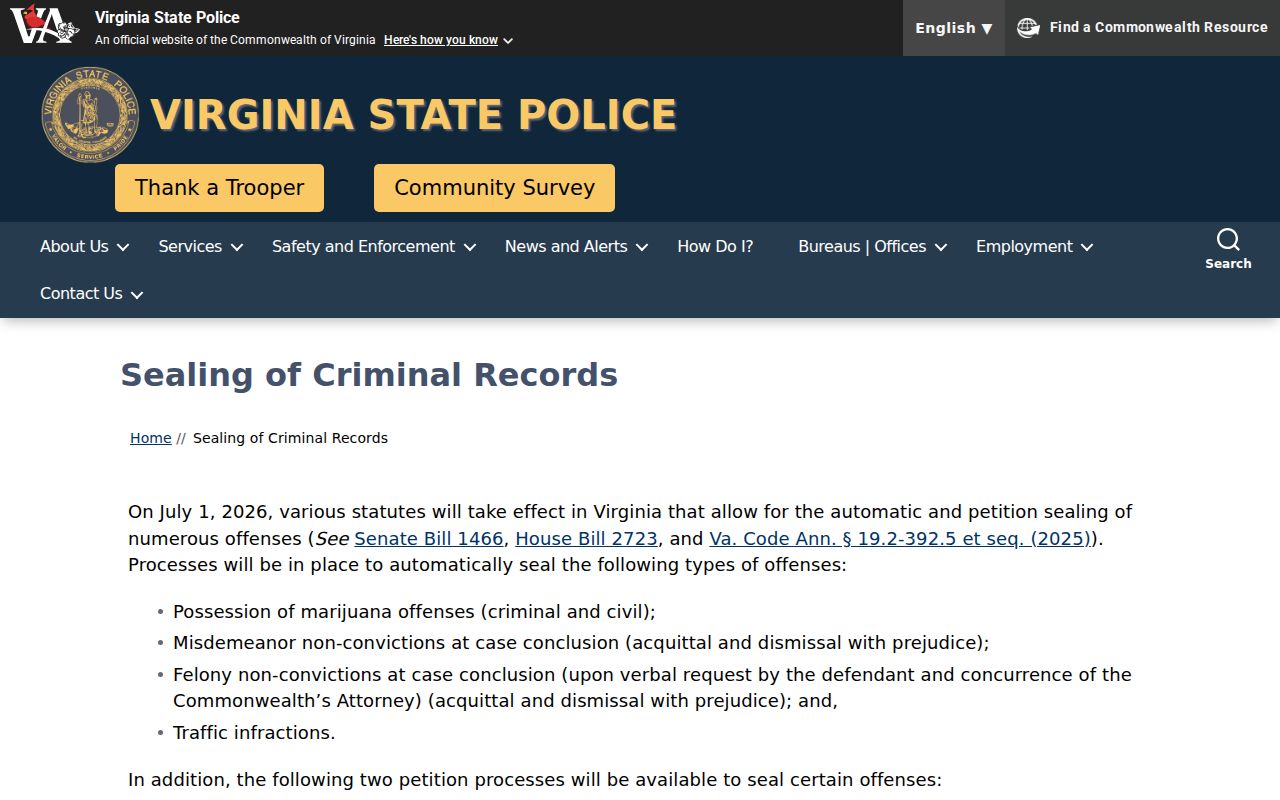
After relief is granted, retain the signed order, allow processing time, and audit both the court index and a personal VSP record. Sealing can limit disclosure without destroying every copy or blocking all uses allowed by law.
Fairfax County Specialty Court Records
Fairfax County operates named treatment-oriented paths that include Recovery Court, the Veterans Treatment Docket, and the Mental Health Docket. Diversion First also marked ten years in 2026, reflecting a local effort to connect crisis response with alternatives to jail where rules allow. These programs affect how a case moves, but participation does not automatically erase the arrest, booking, or court docket.
The Fairfax Commonwealth’s Attorney describes collaborative specialty dockets. A searcher should still read the final disposition and any later sealing order. A deferred result depends on the governing statute and compliance, while a dismissal ends that charge in the proceeding but may leave the earlier booking visible until lawful relief is processed. The record’s final status comes from the signed court order, not the program name alone.
Note: Treatment or diversion can change a Fairfax County case outcome, but only a qualifying sealing or expungement order changes later access.
Fairfax County Booking Record Context
The Adult Detention Center’s three connected buildings show how Fairfax County custody has changed. East opened in 1978 with linear, single-cell medium-security housing. North followed in 1987 with podular maximum-security space. West opened in 2000 and uses direct supervision for minimum-security housing. Together they have a rated capacity of 1,260.
The large gap between annual bookings and average daily population shows turnover, not a count of convictions or unique people. Each intake can yield an ADC booking record even if prosecutors later change the charge or the court dismisses it. The Fairfax County arrest lookup explains the full agency, jail, court, and state fallback chain.
Correcting a Fairfax County Arrest Record
If a dismissed Fairfax County arrest still appears, first identify which custodian displays it. Obtain the final signed order from the proper court and compare it with the police report, ADC booking, public docket, and personal CCRE record. A mismatch in charge or disposition belongs with the agency holding that incorrect field. CCRE provides a challenge process for descriptive data tied to another person and for incorrect reported outcomes.
Correction is not the same as expungement or sealing. Correction fixes inaccurate data. Relief changes lawful visibility of an accurate event. When identity is disputed, VSP may require fingerprinting for a record challenge. When a disposition is wrong, certified court material supplies the source proof. Allow time after any correction or sealing order, then check each relevant Fairfax County and Virginia system again.
Fairfax County Criminal Records by City
Fairfax County has three incorporated towns: Herndon, Vienna, and Clifton. Herndon and Vienna keep their own police records, while Clifton has no verified town police department and relies mainly on Fairfax County Police or the agency that responded. All three route county criminal cases through Fairfax General District Court and, for a felony that advances, Circuit Court. The city pages keep each town’s distinct request rules at local depth.
Herndon Criminal Records
25,506 residents in the 2025 estimate. Herndon Police maintains town reports and a weekly crime report.
Vienna Criminal Records
16,691 residents in the 2025 estimate. Vienna offers a free local self-history report in person.
Clifton Criminal Records
243 residents in the 2020 Census. FCPD and Fairfax County courts provide the main criminal record routes.