
Sex Offender Checks in Fairfax County
The Virginia Sex Offender and Crimes Against Minors Registry is the controlling public channel for a Fairfax County sex offender search. Virginia State Police maintains it. The database can be filtered to Fairfax County, a town, a ZIP code, an address, or a mapped area. The U.S. Department of Justice’s national search adds a cross-state layer when a person may have moved or when the relevant address lies near a jurisdictional border.
Fairfax Sheriff and local law enforcement perform local registration and verification duties, while VSP controls the statewide data. That split matters when something looks wrong. A database or technical issue belongs with the VSP registry unit. Suspected failure to register can be reported to local law enforcement. An urgent threat belongs with 911. The Fairfax County Sheriff and Fairfax County Police are county channels for local concerns, not substitutes for the official public registry.
A registry search has limits. A blank result does not prove that someone has no criminal record. Only offenses and statuses that trigger Virginia registration duties appear. The public profile also does not replace the conviction file, signed order, or a lawful criminal-history product.
Fairfax Registry Search Routes
The redesigned Virginia registry supports several ways to narrow a Fairfax County check. A name route works when spelling and identity are known. Address, ZIP, radius, and map routes are more useful for neighborhood awareness. An SOR number targets one known state registration record. Status filters can isolate incarcerated, homeless, or civilly committed registrants.
Begin wide enough to account for spelling and location changes, then compare profile fields before drawing a conclusion. A city-only search may omit someone whose address uses another postal name within Fairfax County. The county filter and map can reduce that risk. The registry’s live controls should govern because labels and radius choices can change.
The official interface displays the current Virginia search choices.
This image comes from the Virginia public registry search.
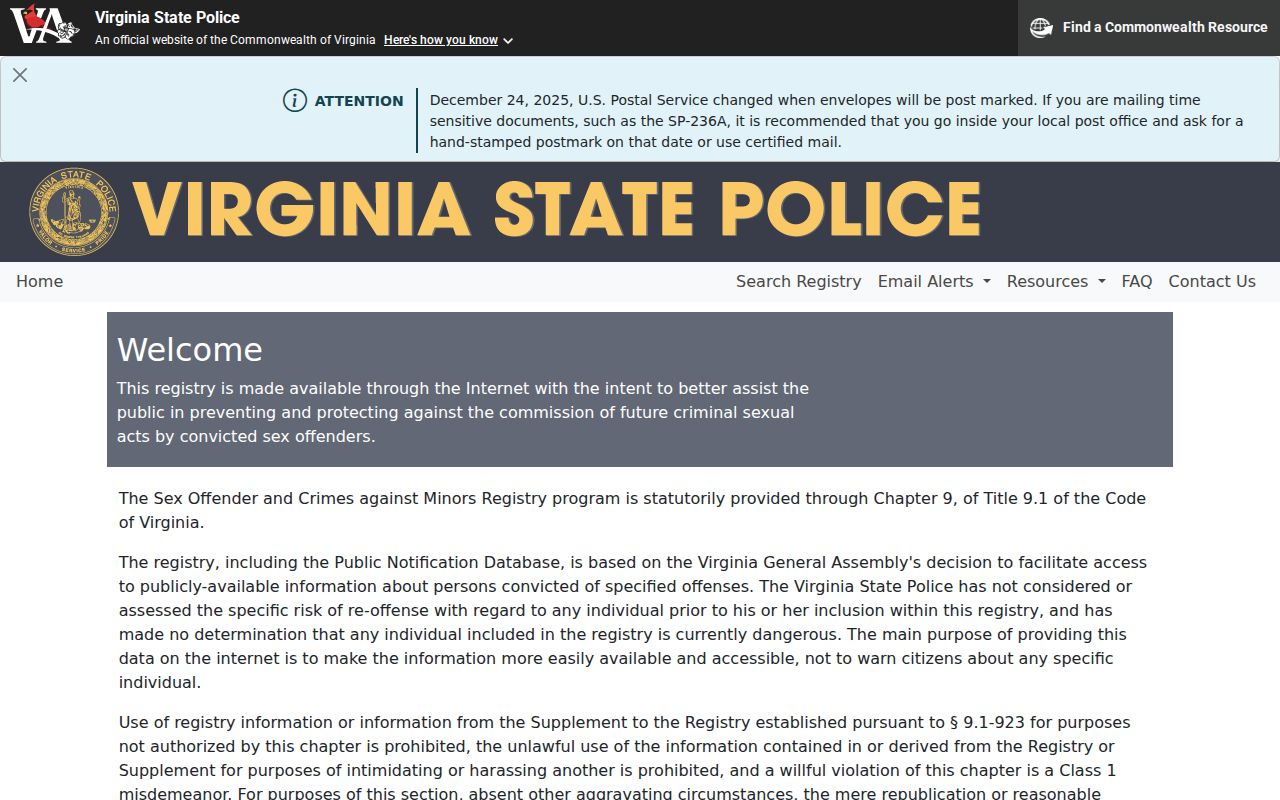
The captured controls show why a Fairfax County registry review can use both identity and place-based routes.
How to Search the Virginia Sex Offender and Crimes Against Minors Registry
A sound Fairfax County sex offender search uses the official site and checks the resulting details, not merely the count of matches. The registry presents terms and lawful-use conditions before or during access. Read them, choose the search that fits the known facts, and avoid assuming that a similar name identifies the same person.
- Open the Virginia public registry and review its terms and public-protection purpose.
- Search by name or SOR number, or choose Fairfax County, address, city, ZIP, radius, or map controls.
- Use status filters only when they answer the specific question, then compare the result list carefully.
- Open the matching profile and review status, verification date, address notation, offense, and reporting agency details.
| Field Label | Type | Required | Options or Notes |
|---|---|---|---|
| Name | Text | Optional | Name-search route; follow live exactness guidance |
| SOR Number | Text | Optional | Virginia registry identifier |
| Address | Text | Optional | Location search |
| City or County | Text or dropdown | Optional | Select Fairfax County among Virginia localities |
| ZIP Code | Text | Optional | Five-digit ZIP |
| Radius or map area | Dropdown or map | Optional | Use current live radius choices or geographic browsing |
| Status filters | Checkboxes | Optional | Incarcerated, homeless, or civilly committed |
Note: Search more than one field when a Fairfax County address, spelling, or status may have changed since the last known information.
Fairfax and National Registry Searches
The National Sex Offender Public Website searches participating public registries across jurisdictions. It is useful when a person may have moved outside Virginia or when a location search near Fairfax County should not stop at the state line. The Virginia registry remains the best source for Virginia-specific profile labels, local filters, state status, and agency contacts.
Use the two systems as layers, not competing verdicts. Start with Virginia for a Fairfax-focused check. Add NSOPW when the search crosses state boundaries. If the displays differ, return to the Virginia profile and contact the VSP registry unit about database questions rather than guessing which record is current.
The Justice Department publishes the national search as an official cross-state channel.
This view was captured from the National Sex Offender Public Website.
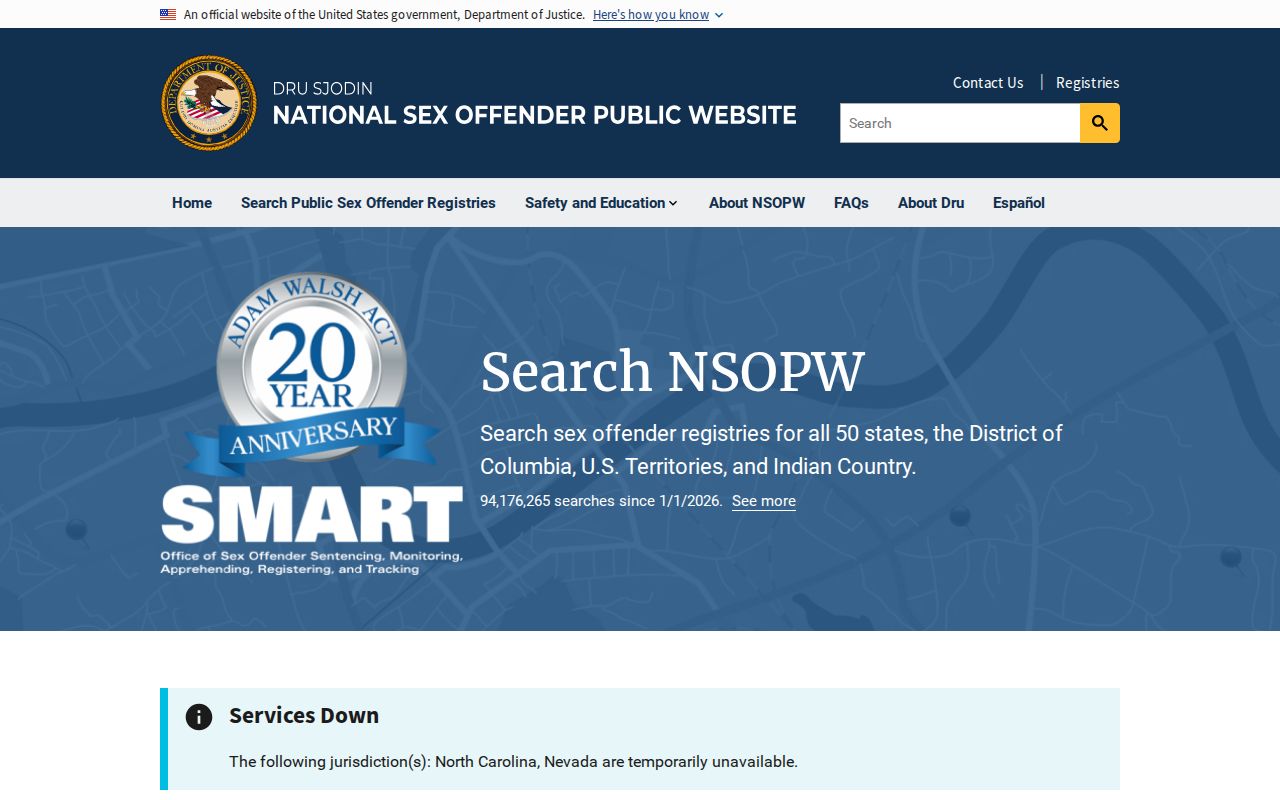
The national layer broadens a Fairfax County search without replacing the record maintained by Virginia State Police.
Inside a Registry Profile
A Fairfax County registry result assembles identity, location, offense, and compliance labels that state law allows the public to see. Fields can be blank or vary by the person’s status. A photo and address help distinguish similar names, but all details should be read together. The profile is built for notification and public protection, not as a full chronology of every arrest or court event.
| Name, aliases, and SOR number | Public identity labels and the state registry identifier. |
|---|---|
| Photo and description | Photograph plus authorized age, sex, race, height, weight, hair, eyes, scars, marks, or tattoos. |
| Address or residence status | Registered location and homeless, incarcerated, or civilly committed notation where applicable. |
| Offense information | Conviction description, jurisdiction, statute, date, and authorized victim-age category. |
| Registration status | Compliance status and last verification or update. |
| Other public fields | Vehicle, work, school, map, agency, or report-a-problem fields when authorized and populated. |
Never retain or republish a private person’s registry profile merely to illustrate these fields. The field labels are enough to explain how a Fairfax County sex offender record is structured. For the underlying conviction, obtain the signed court order from the court that entered it.
Fairfax Registry Profiles vs Court Files
A public registry profile and a criminal case file answer different questions. The profile tells the public about a current registration duty and the state-approved details tied to it. The conviction file shows the charge, plea, orders, disposition, and sentence. A profile is therefore not a substitute for Fairfax County criminal court case records, even when the conviction arose in Fairfax.
Use the profile’s offense description, jurisdiction, statute, and date to identify the proper court. Then search the court index and request the order if the legal outcome matters. Virginia’s public registry does not claim to be a complete rap sheet. It also does not list every person with a criminal case, because most offenses do not create a registry duty.
| Record | Best Use | Key Limit |
|---|---|---|
| Virginia registry profile | Current registration status and public-notification details | Not a complete court or criminal-history record |
| Fairfax court file | Filed charge, plea, disposition, judgment, and sentence | Does not by itself describe current registry compliance |
| VSP criminal history | Authorized identity-based Virginia history | Access depends on the requester and lawful purpose |
Virginia Registration Levels and Requirements
Virginia registration duties depend on the offense category. Tier I commonly uses annual verification and a court-removal framework after the statutory period, often 15 years when eligible. Tier II generally uses semiannual verification and a longer statutory period, commonly 25 years when eligible. Tier III or sexually violent offenses generally require verification every 90 days and lifetime registration. Specified murder and former Section 18.2-67.2:1 cases also carry lifetime duties.
| Virginia Category | Duration | Verification | Public Significance |
|---|---|---|---|
| Tier I | Commonly 15 years, subject to eligibility and court removal | Generally annual | Included under Registry Act and database rules |
| Tier II | Commonly 25 years, subject to eligibility and court removal | Generally semiannual | Public notification under Virginia law |
| Tier III or sexually violent offense | Lifetime under Va. Code § 9.1-908 | Generally every 90 days | Continuing lifetime duty unless law provides otherwise |
| Specified murder or former § 18.2-67.2:1 case | Lifetime under Va. Code § 9.1-908 | As the Registry Act requires | Continuing duty |
Section 9.1-904 governs reregistration and verification frequency, while Sections 9.1-908 through 9.1-910 address duration and removal. Confinement tolls the otherwise applicable registration period. The exact Virginia offense classification should control instead of assuming that a federal label maps neatly onto the state category.
Fairfax Registry ZIP Code Alerts
Virginia State Police Form SP-285 lets a requester ask for notice of registration or reregistration in the same or a contiguous ZIP code. The form captures the requester’s identity and contact details, the ZIP area, the delivery preference, and the signature and date shown on the current version. It supports ongoing Fairfax County community awareness without repeated manual name checks.
Use the live form at filing time because fields and delivery choices can change. ZIP-based notice is broader than following one person, but it still reflects the statutory registration system. It should be paired with the current public profile and reasonable safety planning, not rumor or informal lists.
The Registry Act defines the statewide duties and notification framework.
This image was captured from the official Virginia Sex Offender and Crimes Against Minors Registry Act.
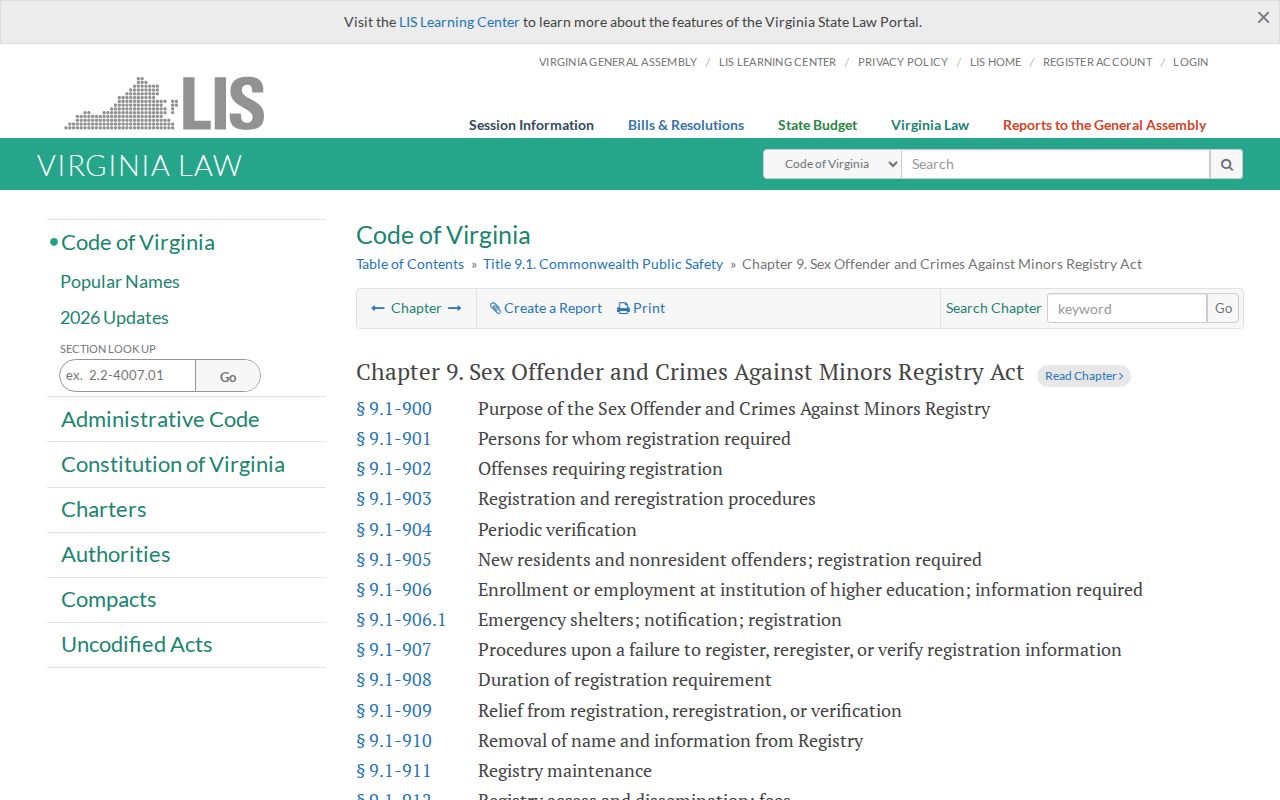
The statute provides the legal context for Fairfax County verification, public access, notice, and misuse rules.
Community Notification and Lawful Use
Virginia makes registry information public for protection and informed safety planning. It is not an invitation to confront, follow, threaten, or shame a registrant or members of a household. Fairfax County residents should use official information calmly, check dates and status, and direct concerns to the agency equipped to act.
Va. Code § 9.1-912 controls dissemination of registry information. Va. Code § 9.1-914 addresses misuse and penalties. These rules sit alongside ordinary criminal laws that prohibit threats and intimidation. The public purpose is notice, not vigilantism.
Use registry data lawfully: Misusing Virginia registry information to harass, threaten, or intimidate a registrant or household is a crime under Va. Code § 9.1-914.
Fairfax County registry information may be incomplete or change after a verification, move, court order, or agency update. Use the profile’s agency and report-a-problem functions when available. Do not spread an unverified claim based on a similar name or old address.
Report Fairfax Registry Concerns
Choose the reporting path by the problem. For a wrong address, broken profile function, or data question, contact the VSP Sex Offender Registry unit at 804-674-2825 or sor@vsp.virginia.gov. For suspected noncompliance in Fairfax County, contact the Fairfax Sheriff or the police agency with local jurisdiction. Use 911 only for an immediate emergency.
Give the agency the profile’s SOR number, the public field that appears wrong, and the reason for concern if those details are available. Do not investigate at a residence or confront anyone. Law enforcement can compare the report with nonpublic verification material and decide what action is lawful.
The access chain is straightforward: Virginia registry for the public record, VSP registry staff for database questions, Fairfax law enforcement for suspected local noncompliance, and 911 for an urgent safety threat. The Fairfax County agency directory can confirm the current local office, while NSOPW remains the official cross-state search layer.
Note: A changed or missing Fairfax County registry entry calls for official verification, not a conclusion that registration duties ended or misconduct occurred.